
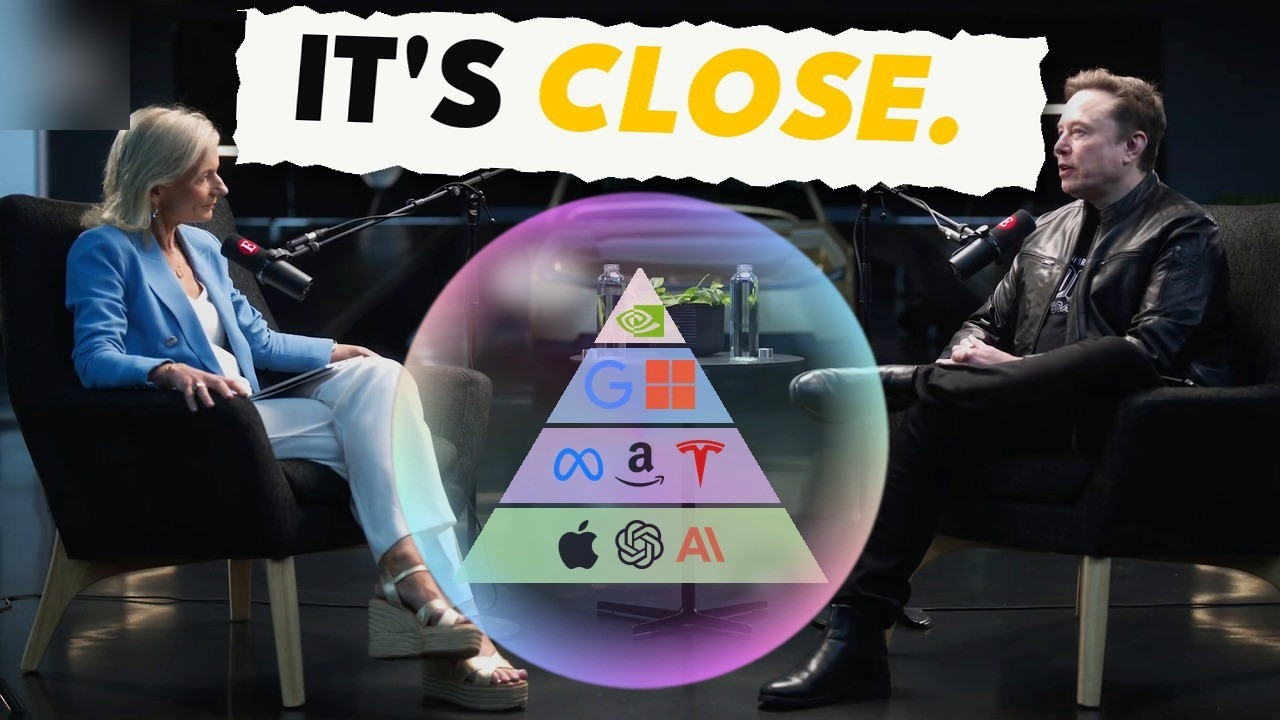
Elon Musk told The Economist this past July that AI may pass the sum of human intelligence in roughly five years. In his mind, it's close. And he might be right. The tools are getting better every month, and I use them in my own business every day.
There's a different clock running at the same time, and it's a lot shorter than five years. The stock market has bet trillions of dollars that AI pays off before anything else breaks. If something underneath it cracks first, that bet goes the wrong way. And the thing that cracks probably won't be AI at all.
Prefer to watch? Watch the full video on YouTube.
Is AI a bubble, or is the weak spot elsewhere?
If you own an index fund in your retirement account, a good chunk of your money is riding on AI, whether you intended to do that or not.
Not everybody in charge sees it as a bubble. The Fed chair, asked about it last October (as of the video), pointed out that today's highly valued companies actually have earnings, unlike a lot of the ideas in the late-90s dot-com period. He has a point. Nvidia, Microsoft and Google make real money.
The weak spot is who's paying them. Steve Eisman, the investor from The Big Short, estimates that OpenAI and Anthropic make up roughly 70% of the AI revenue the big cloud companies are booking. He's been clear he can't verify that number himself. But if it's even close, a huge share of the money holding this up comes from two companies that are still burning cash.
Are we building a bubble that's about to pop? Honestly, that's not what worries me most. What worries me is what the bubble is sitting on.
Card 1: power. The grid can't keep up with data centers
Every AI model runs in a data center, and every data center needs a massive amount of electricity.
As of the video, about 2,000 gigawatts of new power plants are waiting in line just to plug into the US grid. For the projects that actually got built last year, the typical wait was about five years. In Texas, the grid operator is tracking about 474 gigawatts of big new customers asking for power, and about 90% of that is data centers.
When the grid can't keep up, companies get creative. Environmental groups said Elon's AI company, xAI, ran up to 35 gas turbines at its Memphis data center, many without permits, and only fifteen ended up permitted. Getting more turbines isn't easy either. Big makers like GE Vernova and Siemens Energy have backlogs stretching years out.
China, meanwhile, added 543 gigawatts of new power capacity in 2025 alone (as cited in the video). Since 2021, it has added more than the entire US grid, and it now generates more electricity in a year than the US, the European Union and India combined.
The models move weekly, but power plants take years to build. That gap is the problem.
Cards 2, 3 and 4: debt, the stock market and housing
Think of what's underneath the AI story as a house of cards with four cards holding it up.
- Power. The grid can't connect new supply fast enough.
- Debt. The federal government is borrowing at a pace that makes every rate decision harder, and a lot of the data center buildout is being funded with borrowed money too.
- The stock market. With so much of the index tied to a handful of AI names, any stumble in AI hits pensions, retirement accounts and anybody with an index fund.
- Housing. Homes are still out of reach for a lot of younger buyers, and that pressure doesn't care how smart the chatbots get.
None of those four are AI problems. AI didn't cause them, and it can't fix them overnight. The bubble just leans on all of them at once. If one card slips before AI delivers the abundance Elon keeps talking about, the whole thing gets shaky.
That's the race. AI has to get good enough, fast enough, to help before those cards fall. It feels to me like we're on a precipice. On one side, profound innovation and abundance. On the other side, if we get this wrong, the global financial system takes a hard hit. I don't know anybody who can time that consistently.
What still has value if some of those cards fall
Which brings up the question that matters for your money. If some of those cards do fall, who's still standing?
Elon describes the good outcome as an age of amazing abundance, where anyone can have anything they can think of. Maybe. I sure do hope he's right. But even in the best case, abundance shows up first for whoever owns the things AI needs. The Fed has said investment in equipment and the things that go into creating data centers is clearly one of the big sources of growth in the economy right now.
Here's how I'm thinking about what still has value in five years, bubble or no bubble.
- Power and infrastructure. Every data center on that waiting list needs electricity, land, water and transmission. The people who own those pieces tend to get paid whether the AI company on top wins or loses.
- Housing. People need a place to live no matter which chatbot is winning. The biggest AI stocks trade around 24 times next year's earnings, and some AI names go for 40 times or more. Rentals in boring markets in the Midwest and Southeast usually don't. Our buy-and-hold guide covers the basics if you're getting started.
- Essential local businesses. The plumber, the storage facility, or the laundromat. A language model can't fix a water heater, at least not yet. Plenty of those mom and pop owners will sell on seller financing terms, meaning the seller acts as the bank and you pay them over time.
Owning things AI needs, and things AI can't replace, is how I'm thinking about it. It's not a guarantee. No investment is. Real assets can lose value in a downturn too. But they still produce cash while the market argues about valuations. You make money when you buy right, starting with the NOI, the net operating income, and assumptions you can defend.
What this means for you as an investor
Keep the hedge in mind. The power wait times, the China capacity numbers, the Eisman estimate and the AI stock multiples are as of the video, and dated claims will age. This isn't financial advice, so run your own numbers and talk to your own advisors.
Debt might be the heaviest of the four cards. The next video in the Own The Asset series digs into what happens when a country owes more than its economy can comfortably carry, and where that leaves you as an owner.
Talk shop with other investors
If you want to learn how to evaluate a deal, or you want other investors walking the numbers with you, come join us in Commercial Real Estate 101 on Skool. You'll get scripts, toolkits, deal breakdowns, and a group of people doing the same work.
And go make some offers.
Frequently asked questions
Is AI a bubble?
AI may or may not be a bubble, and I don't know anybody who can time it consistently. The Fed chair pointed out that today's highly valued AI companies actually have earnings, unlike a lot of late-90s dot-com ideas, so what worries me more is what the AI boom is sitting on.
What is the biggest risk underneath the AI bubble?
The bigger risk is the four cards the AI boom leans on: power, debt, the stock market and housing. None of those four are AI problems, and if one slips before AI delivers, the whole thing gets shaky.
Why is power a problem for AI data centers?
Every AI model runs in a data center that needs a massive amount of electricity, and the grid can't connect new supply fast enough. As of the video, about 2,000 gigawatts of new power plants were waiting in line to plug into the US grid, and projects built last year typically waited about five years.
How does the AI bubble affect my retirement account?
If you own an index fund in your retirement account, a good chunk of your money is riding on AI whether you intended it or not. With so much of the index tied to a handful of AI names, any stumble in AI hits pensions, retirement accounts and anybody with an index fund.
What still has value if the AI bubble bursts?
I'm looking at things AI needs and things AI can't replace: power and infrastructure, housing, and essential local businesses like plumbers, storage facilities and laundromats. That isn't a guarantee, because real assets can lose value in a downturn too, but they still produce cash while the market argues about valuations.