
About four million Americans drive for a living, in trucks, delivery vans, taxis and ride share. In several American cities today, you can already get in a car with nobody behind the wheel and pay for the ride.
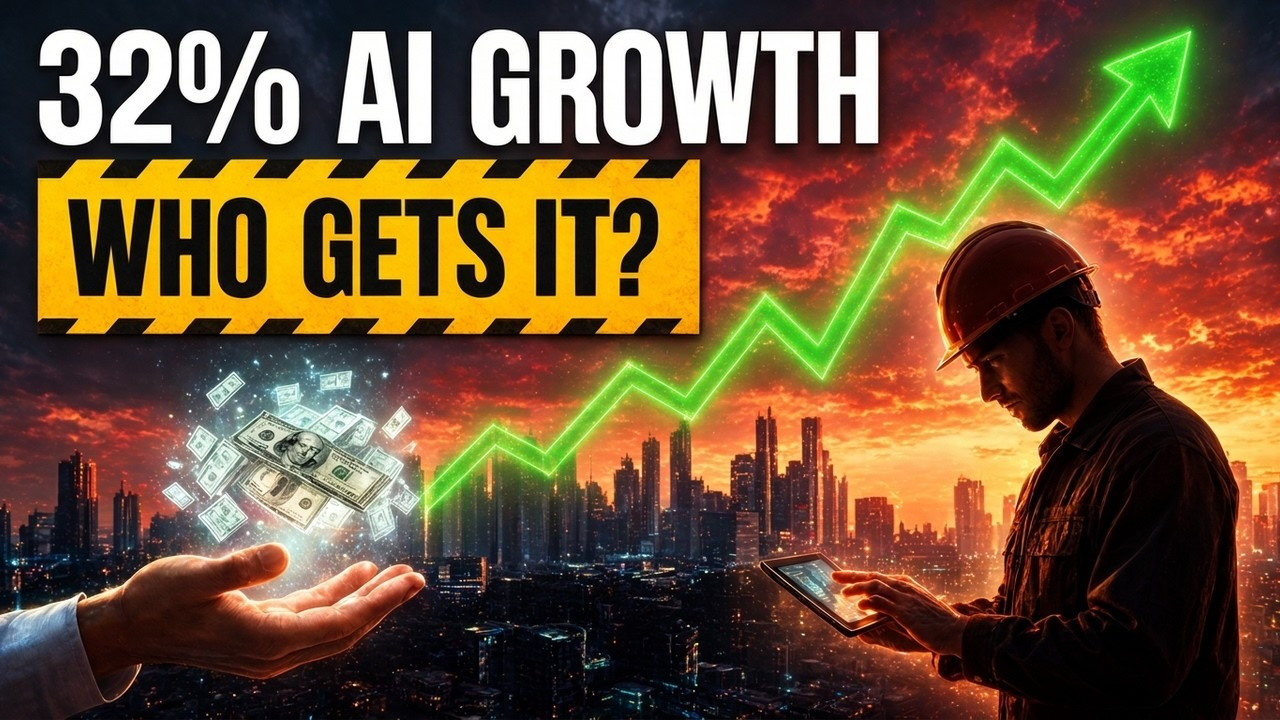
Anthropic, the company that makes the AI model Claude, just helped publish a 57-page working paper on what the US economy could look like by 2030. In its most extreme scenario, the economy ends up 32% bigger than it would have been without AI. But total pay for workers, all of it added together, barely moves.
That's a lot of new money, and somebody gets it. Who that somebody is, and why the drivers aren't even counted in it yet, is what you need to be thinking about as an investor, even if you're not a tech billionaire.
Prefer to watch? Watch the full video on YouTube.
What the Anthropic AI economy report actually says
First, a fair warning about the source. This is a working paper from the Anthropic Institute, written by five economists, including Anton Korinek and Charles Jones. They built three scenarios they call modest, substantial and extreme. They say plainly that the scenarios are not predictions, and they attach no probabilities to them.
I appreciate that, because I don't know anybody who can time this stuff consistently. The point of the paper is to see what happens to the money under each path.
The three AI growth scenarios for 2030
- Modest: the economy in 2030 is about 1.5% bigger than it would have been without AI, which is barely noticeable.
- Substantial: the economy is about 8% bigger.
- Extreme: the economy is about 32% bigger, and it's growing about 15% a year by 2030. The model assumes roughly 2% a year without AI.
One more detail is worth knowing. Almost all of the difference between these paths shows up after 2027. That means the next year or so might look normal, and then it might not.
The CEO of Anthropic has said he thinks fast growth is coming. That's his opinion, and he sells AI, so weigh it that way. It does line up with the extreme scenario in his own company's report.
Labor share explained: where the money goes if the economy grows 32%
Economists track something called the labor share. Meaning, out of every dollar the economy earns, how much goes to the people doing the work through wages and salaries. Today it's about 60 cents.
In the extreme scenario, the labor share falls to about 45 cents by 2030. The report does the math right out in the open. The pie gets about a third bigger, and the worker slice shrinks by about a quarter, so the two cancel out.
Let's look at a simple example with round numbers.
- Without AI: for every $1.00 the economy earns, about 60 cents goes to workers.
- With 32% growth: the economy earns about $1.32 instead of $1.00, and workers get 45 cents of each dollar. That works out to about 59 cents.
- The result: total labor income in 2030 is almost exactly what it would have been with no AI at all.
Every dollar of that growth goes to capital. In the report, capital income ends up 81% above where it would have been. Capital means the people who own things, like the data centers, the companies, the buildings and the equipment.
That answers where the money goes. In the extreme case, the owners get the growth, and the workers as a group stay about where they were.
Office jobs vs hands-on jobs
It isn't spread evenly among workers either. The report splits jobs into two groups.
- Cognitive jobs, meaning office and knowledge work, see wages about 11.5% lower than they would have been. Unemployment for people who started in those jobs hits about 18%.
- Everyone else, the people in hands-on jobs, sees wages about 34% higher.
The report even prices the fix. To make office workers whole, you'd need a transfer of about 9% of the economy. That's roughly the size of Social Security and Medicare combined, and the authors point out that nothing like that has ever happened in response to a new technology.
The robotics gap: why drivers aren't in the AI report yet
There's one line buried in the report that changes how I read it. The model only covers cognitive tasks, which is thinking work. In the authors' own words, it does not allow for rapid advances in robotics.
That means the hands-on jobs that come out ahead in the model, like driving, assume the robots don't show up by 2030.
This next part is my read, and it goes past the report, so I'd hedge it. Self-driving has been "five years away" for a long time. But the cars are on the road today. Waymo gives paid rides with no driver in multiple US cities, and Tesla started running its Cybercab, a car built with no steering wheel, in Austin this September.
Let's look at a simple example. A delivery company pays a driver around $60,000 a year. If a self-driving van runs that route, the $60,000 doesn't vanish. It turns into profit for whoever owns the van and the software. That's the same pattern as the report, just moved into physical work.
There are real caveats here. The government's count of about four million drivers is a floor, because a lot of part-time ride share drivers don't get counted well. And plenty of driving jobs come with loading, lifting and dealing with customers, which is harder to automate. It's likely this takes longer than the hype says, but there's no guarantee it takes as long as you'd want.
What to own if AI growth flows to owners
If the growth flows to owners, the practical question is what you can own.
I'm not a fan of guessing which AI stock wins. I'd rather own things that AI makes more valuable, or that AI can't easily replace.
- Housing. People still need a place to live no matter who does the work, and that's why I own rentals. If you're just getting started, our buy-and-hold guide walks through the basics.
- Power and the land around it. Data centers need enormous amounts of electricity, and that power has to come from somewhere.
- Small businesses that do hands-on human work. Think of plumbers, electricians, HVAC companies, laundromats and self-storage.
Many of those small business owners are mom and pop operators getting close to retirement. Plenty of them will sell on seller financing terms, meaning the seller acts as the bank and you pay them over time instead of getting a bank loan.
Risk comes first
Every one of these has risk, like vacancy, repairs, bad tenants or just buying a bad deal. You make money on them when you buy right with conservative assumptions. That starts with the NOI, the net operating income, and a cap rate you can defend.
The goal is to be on the side of the table that collects the growth, because that's where the report says the money goes.
What the AI economy report means for you
This is where it gets uncomfortable. If you're a worker (and most of us still are, in some form), the report says your total pay might not move much. That means the main lever you control is what you buy with that pay, and how soon.
Keep the hedge in mind, too. The authors call these scenarios, not predictions, and nobody should bet the farm on the extreme case. This isn't financial advice, so run your own numbers and talk to your own advisors.
One question I keep coming back to: which job do you think goes next after drivers?
Talk shop with other investors
If you want to learn how to evaluate deals like this, or you want other investors walking the numbers with you, come join us in Commercial Real Estate 101 on Skool. You'll get scripts, toolkits, deal breakdowns, and a group of people doing the same work. Bring your answer on which job goes next, and we'll talk shop.
And go make some offers.
Frequently asked questions
How will AI impact the economy by 2030?
A 57-page Anthropic Institute working paper models three scenarios where the US economy in 2030 ends up about 1.5%, 8% or 32% bigger than it would have been without AI. The authors say plainly these are scenarios, not predictions, and they attach no probabilities to them.
What is labor share?
Labor share is how much of every dollar the economy earns goes to the people doing the work through wages and salaries, and today it's about 60 cents. In the paper's extreme scenario, labor share falls to about 45 cents by 2030.
Who gets the money if AI grows the economy 32%?
In the paper's extreme scenario, the owners of capital get the growth, and capital income ends up 81% above where it would have been. Total worker pay in 2030 is almost exactly what it would have been with no AI, because the pie gets about a third bigger while the worker slice shrinks by about a quarter.
Which jobs does AI hurt most in the Anthropic report?
Office and knowledge jobs take the hit in the report, with wages about 11.5% lower than they would have been and unemployment for people who started in those jobs hitting about 18%. People in hands-on jobs see wages about 34% higher, but only because the model doesn't allow for rapid advances in robotics.
What should investors own if AI growth goes to owners?
I'd rather own things AI makes more valuable or can't easily replace, like housing, power and the land around it, and small businesses that do hands-on work. Every one of those has risk, like vacancy, repairs or buying a bad deal, so it starts with an NOI and a cap rate you can defend.