
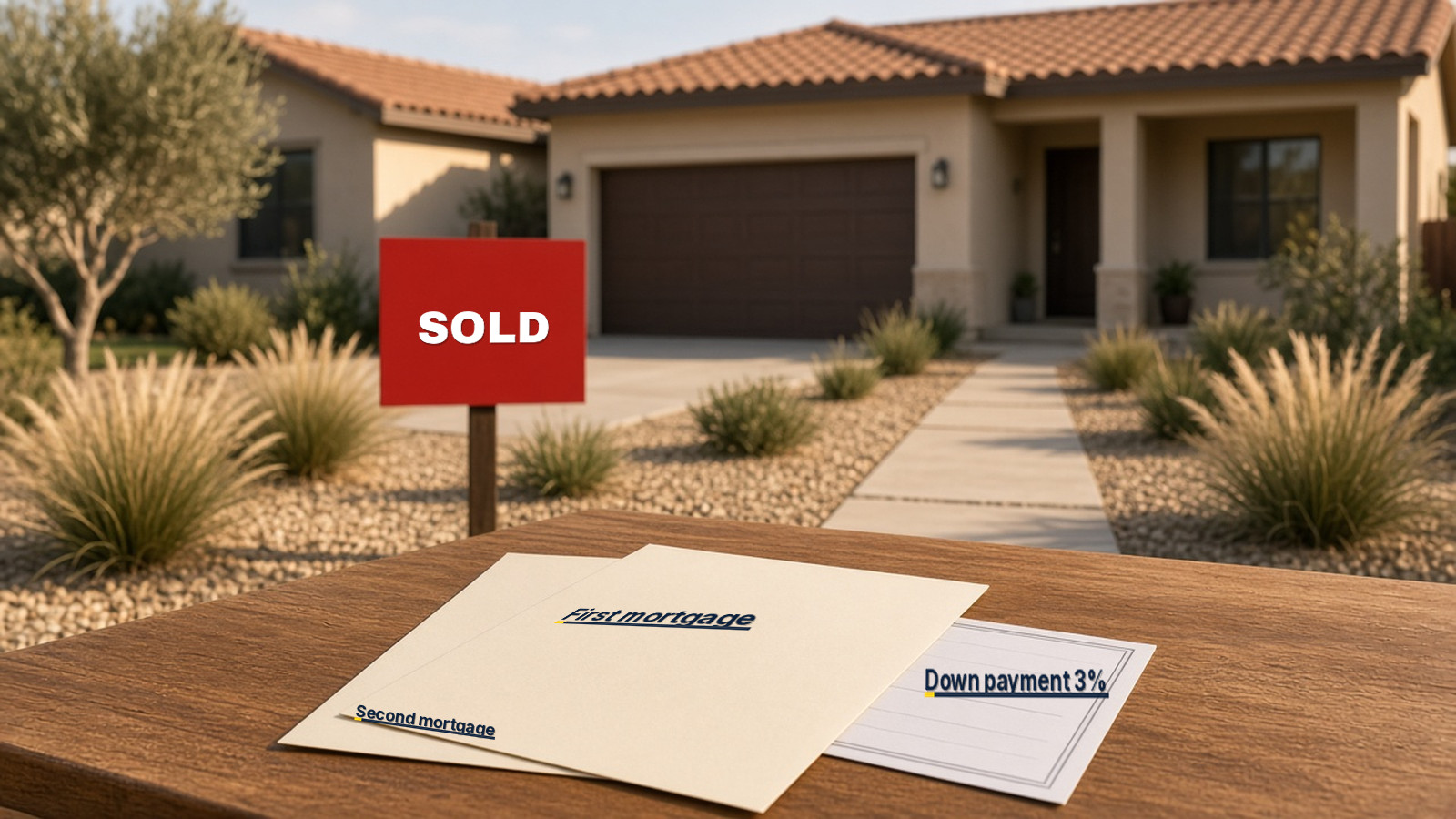
California voters approved Proposition 37 on November 3, 2026, a program that can get an eligible buyer into a qualifying new home with 3% down. The buyer still has to repay almost the whole purchase price, split across a first mortgage and a second mortgage from the state. If you're a California buyer, or an investor watching new-home demand, the question is whether that smaller cash requirement actually makes the house affordable to hold. Getting the down payment together and being able to afford the house are two different problems.
Prefer to watch? Watch the full video on YouTube.
What Prop 37 actually does
The official ballot summary says Proposition 37 authorizes $25 billion in bonds so the California Housing Finance Agency (CalHFA) can offer eligible buyers a fixed-rate second mortgage of up to 17% of the purchase price of a qualifying newly constructed home. The buyer has to bring at least 3% down. The bonds are repaid by the homeowners' loan payments, not by the state's General Fund. The Legislative Analyst's Office analysis calls this second loan a "middle-class homeownership loan."
A second mortgage is another loan against the same home, and the buyer has to repay it along with the first mortgage. Prop 37 changes where part of the purchase money comes from. It does not make the home cost less.
Election results are still unofficial. The Secretary of State is due to certify the Statement of Vote by December 11, 2026. News organizations projected the measure as passing after Election Day, and mid-November unofficial counts showed a clear yes majority. Approval of the measure also does not mean loans are available today. The official text of the law gives CalHFA up to one year after the effective date to implement the program, and CalHFA still has to set the interest rate, repayment schedule, and other terms.
How an $800,000 new home would be split
Imagine a hypothetical $800,000 qualifying new home, and you're comparing a 20% down payment with the minimum buyer contribution under this program. Twenty percent down is $160,000. Three percent is $24,000. Saving $24,000 feels a lot different from saving $160,000, especially if you're paying rent along the way.
Under the program's 17% maximum, the second mortgage could cover up to $136,000. The first mortgage would cover the remaining $640,000. The buyer brings less cash to closing, and still owes $776,000 across the two loans, with closing costs and any required reserves on top.
The program uses the homeowner's loan payments to repay the bond investors. For the buyer, assistance means borrowing more of the purchase price, not having the unpaid portion forgiven. The actual interest rate and terms on both loans still have to come from the program and your lender. Those rates are not published yet.
Who qualifies, and which homes count
Before you start shopping with a smaller down payment in mind, check whether you and the property even qualify. Under the official text:
- You generally need to have lived in California for at least one year before you apply.
- Your family income can be no higher than 200% of the area median income for a family of the same size in that county or metro area. Area median income is the middle income for a similar-size family in that market, as the agency adjusts it.
- You have to live in the home as your primary residence within 60 days of closing.
- The 3% has to come from a source other than a grant or borrowed money.
- The home has to be a qualifying newly built house, townhome, condo, or manufactured home, or the first sale of a unit converted from nonresidential use, and you have to be the first purchaser.
Existing resale homes are not the main target. If the house is a 10-year-old three-bedroom on a normal street, Prop 37 is probably not writing that second check.
The official ballot summary describes eligible homes as priced below about $1.5 million. The statute sets the cap at 125% of the Federal Housing Finance Agency's one-unit conforming loan limit for that county. For 2026, that works out to about $1.04 million in counties at the baseline limit of $832,750, and about $1.56 million in high-cost counties at the $1,249,125 ceiling. Confirm the current county limit when you shop, because FHFA updates conforming limits each year.
The payment still has to leave you room to live
Being able to sign the loan papers does not mean the payment leaves you enough room to live. I spent years as an engineer before I built a rental portfolio, and the habit that stuck is understanding the full stack of debt, not the marketing number on the flyer. If I were advising a California buyer, I would underwrite the first mortgage, the second mortgage, taxes, insurance, and HOA dues as one payment, and I would only move if that total still left a real cushion.
You still have to be able to afford the new home. What you still owe is nearly the whole price, just split across two loans. If you want a fuller walk-through of the gap between a loan you can get approved for and a payment you can actually live with, my pre-approval budget test runs the whole monthly cost, not just the down payment.
What this means if you're buying or investing
I'd treat Prop 37 as a narrow tool for eligible new-home buyers, once the program is actually open. More demand for new homes can support builders and give sellers more pricing power if inventory stays tight, so I'd watch whether new-construction prices jump in the metros that get the most of these loans.
I would not underwrite an investment offer as if this program is going to save a thin deal. California home prices often do not work for investment properties I look at, and new-home builders rarely accept creative financing. Their business model is to get that inventory off their books and build more homes. For an investment property in California, I'd only make an offer if the rent and the full ownership cost worked at the purchase price. On resale homes, I'd ask whether the seller would carry the note before giving up on the numbers.
If seller financing is new to you, how I bought a rental without a bank loan shows how a seller-carried note changes the payment, and the 100% seller-financing checklist covers due-on-sale and balloon risks when a seller finances more of the price.
The recap
- Proposition 37, approved by voters on November 3, 2026, authorizes CalHFA to sell up to $25 billion in bonds to fund fixed-rate second mortgages of up to 17% on qualifying new homes, with the buyer bringing at least 3% down.
- In a hypothetical $800,000 example, the buyer brings $24,000, the second mortgage can cover up to $136,000, and the first mortgage covers $640,000. The buyer still owes $776,000 across the two loans.
- Eligibility generally includes one year of California residency, income at or below 200% of area median income, owner occupancy within 60 days, and a first-purchase new or converted home under the county price cap.
- Official results are still awaiting certification, and CalHFA has up to one year after the effective date to implement the program. Rates and terms are not set yet.
- Underwrite the first mortgage, the second mortgage, taxes, insurance, and HOA dues as one payment, and only move if that total leaves a real cushion.
The $800,000 home and the loan amounts in this guide are a hypothetical teaching example, not a quote from CalHFA or a claim about a specific property. Interest rates and final program rules are not published yet. Verify eligibility, the county price cap, taxes, insurance, HOA dues, and both loan terms on the actual house.
Get help underwriting the full payment before you offer
If you want help finding a house or a rental you can actually afford to hold, and learning how to structure an offer when a smaller down payment still leaves a large monthly bill, come join us in Commercial Real Estate 101 on Skool. Inside, we run the numbers together, check each other's assumptions, and work through financing terms with other investors.
Pick a property, add up both loans and the rest of the ownership cost, and make an offer you can afford to hold.
Frequently asked questions
Does California Prop 37 let you buy a home with only 3% down?
Eligible buyers of a qualifying new home can bring as little as 3% of the purchase price, with a CalHFA second mortgage of up to 17% and a first mortgage covering the rest. The buyer still owes the remaining 97% across those two loans, plus closing costs and reserves.
Is the Prop 37 assistance a grant or a loan?
It is a loan. The official text requires a second mortgage of no more than 17% of the purchase price, repaid by the buyer, and the bond investors are repaid from those loan payments. The unpaid portion is not forgiven.
Who qualifies for California's Prop 37 3% down program?
The statute generally requires one year of California residency before you apply, family income at or below 200% of area median income, occupancy as a primary residence within 60 days, and a 3% contribution from a source other than a grant or borrowed money. The home has to be a first-purchase new or converted unit under the county price cap.
Does Prop 37 cover existing resale homes?
No. The program is aimed at newly built homes, or the first sale of a unit converted from nonresidential use, where you are the first purchaser. A typical resale house would not get this second mortgage.
Are Prop 37 loans available right now?
No. Voter approval is not the same thing as an open loan program. CalHFA still has to set rates and terms, and the official text gives the agency up to one year after the effective date to implement the program.