
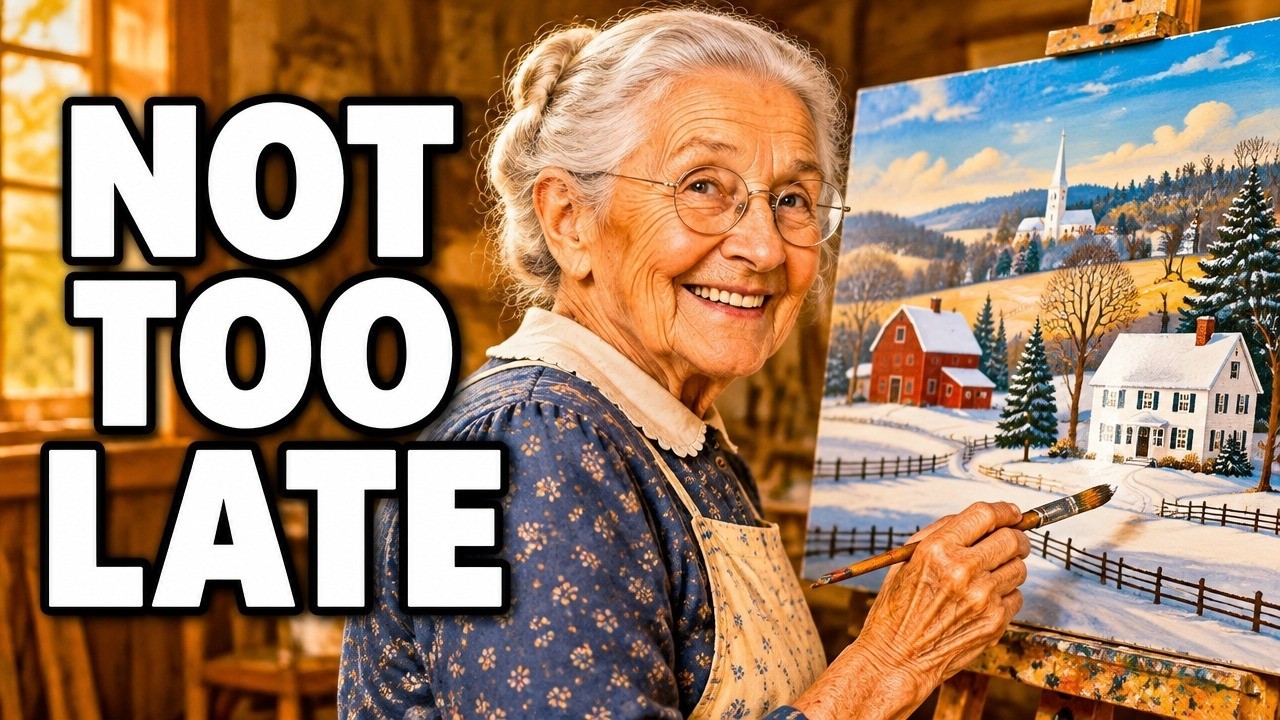
In 1938, an art collector from New York City named Louis Caldor walked past a drugstore window in Hoosick Falls, a small farm town in upstate New York, and bought every painting in it. The woman who painted them was 77 years old, and the world came to know her as Grandma Moses. She had no art training and no gallery, and she had only started painting seriously after arthritis made needlework too hard on her hands. When I coach new investors to get started in real estate, I don't want age to be the reason anyone waits, and her story shows why. Is real estate the only asset you can own, and is it too late to start building one from what you already know?
Prefer to watch? Watch the full video on YouTube.
Who Grandma Moses was
Anna Mary Robertson was born on September 7, 1860, in Greenwich, New York. She went to work as a hired girl on a neighbor's farm at 12, married Thomas Salmon Moses at 27, and spent most of her life running farms with him in Virginia and then in Eagle Bridge, New York. She churned butter to add to the family income. Thomas died in 1927.
Her daughter got her stitching yarn pictures in the early 1930s. When arthritis made it hard to hold a needle, her sister suggested she paint instead. Her paintings sat in the Hoosick Falls drugstore window for a while, next to other crafts made by local homemakers, until Louis Caldor came through town during Easter week of 1938 and bought them all, according to the Kallir Research Institute biography.
Dealers in New York lost interest when they heard her age. Caldor kept at it, and in October 1940 the Galerie St. Etienne gave her a first solo show called "What a Farmwife Painted." She had just turned 80. Right after the show, a Thanksgiving event at Gimbels department store in New York got the press excited about her, and a few months later a journalist picked up the local nickname "Grandma Moses" and made it stick.
When did Grandma Moses start painting?
She started painting seriously in her late 70s. The Smithsonian puts it at 77, and the Kallir biography notes she turned 78 in 1938, the year Caldor found her work. She kept painting until she died on December 13, 1961, at 101, and the Smithsonian American Art Museum says she made more than 1,500 paintings. That's more than 20 years of work that began at an age when a lot of people figure the door is closed.
How her paintings became an asset
Intellectual property is a creation of the mind that the law lets you own, like a book, a song, a painting, an invention, or a brand name. The World Intellectual Property Organization uses that same "creations of the mind" definition, and the main legal tools are copyrights, patents, and trademarks.
A painting on a wall can only be sold once. The right to copy that picture can be licensed again and again, which means someone pays you for permission to use it while you keep owning it. That's the same idea as a rental. You own the building, the tenant pays to use it, and you still own the building when the lease ends.
For Grandma Moses, the licensing went like this, per the Kallir biography and the Galerie St. Etienne:
- In 1946, her dealer, Otto Kallir, oversaw the licensing of the first Grandma Moses Christmas cards.
- In 1947, Hallmark took over the greeting card license.
- Her pictures also showed up on posters, china plates, drapery fabric, and other licensed products.
- In 1951, the gallery set up a separate company, Grandma Moses Properties Co., to register and manage the copyrights and trademarks in her work.
Grandma Moses Properties Co. still handles reproduction requests and licenses today, more than 60 years after she died. And her original paintings kept their value too. On November 30, 2006, her painting "Sugaring Off" (1943) sold at Christie's in New York for $1,360,000 with the buyer's premium, a world auction record for her work at the time.
Late bloomers have more time than they think
A lot of people stop before they start because they tell themselves they're too old. The numbers point the other way.
- An American who reaches 65 can expect to live about 19.7 more years on average, according to the CDC's Mortality in the United States, 2024 data brief (January 2026).
- U.S. life expectancy at birth hit a record 79.0 years in 2024, per the CDC's January 29, 2026 release.
- Around the world, average life expectancy was about 32 years in 1900 and about 73 years in 2023, per Our World in Data (data as of its latest 2023 estimate).
Those are averages, and your health and family history will move your own number up or down. Still, 19.7 years is close to the 23 years Grandma Moses spent painting. We're living a lot longer than the people who came before us, and I'd argue this is the best time in history to be alive.
Intellectual property examples you already carry around
The things people ask you for help with, the skill you've used for 30 years, and the way you solve a problem better than anyone at your job are all creations of your mind. Right now, that knowledge walks out the door every time you stop working.
The U.S. Copyright Office says copyright protects a work the moment the work is created and fixed in a tangible form, like a page, a painting, or a recording. It also says copyright doesn't protect facts, ideas, systems, or methods by themselves, only the way you express them. So what you know becomes something you own once you put it into a form like a book, a course, a set of videos, or a brand.
Take a retired nurse, as an example, who spent 30 years teaching new nurses how to handle a hard shift. If she writes that knowledge down as a guide or turns it into a video course, she owns the guide or the course. She can sell it, license it, or teach from it for years, the same way a rental keeps paying after you buy it once.
These videos and guides are me doing the same thing with real estate. I'm taking what I've learned about finding and buying real estate and putting it into a form that keeps working when I'm not in the room.
Licensing intellectual property vs owning a rental
Both are assets, and both take work before they pay. The difference is where the work shows up.
- A rental pays you rent from the first month you own it, if you buy it right, and the money you need is mostly up front. You can run the numbers before you buy. A duplex renting for $1,400 a side brings in $33,600 a year. Take out 5% for vacancy and about 40% for operating expenses (my starting ratio for 2 to 14 units, with the yearly replacement reserve inside it), and you're left with $19,152 of net operating income before the loan payment. The $200 per door test tells you whether that's enough once you add the mortgage.
- Intellectual property usually costs time more than money to build. You can't run the numbers before you start the same way, and most first attempts won't earn much. Once it's built, though, a guide or a course doesn't need a roof or a tenant.
The duplex numbers are an example, rounded, and not a quote. Neither asset is a sure thing. A paid-off house, a salary, and a retirement account are useful, but none of them pays your bills on its own, which is the point of our guide on income-producing assets.
Find your thing this month
- Write down the three things people ask you for help with most, and pick one.
- Turn that one thing into something you own this month: a written guide, a recorded lesson, or a first set of videos.
- If the asset you want is real estate, pick one listing this week and run the rent, vacancy, and expenses yourself before you ever call the agent. Our real estate investing for beginners guide covers the basics.
Grandma Moses's story is rare, and most first attempts won't earn much. But if you never make the attempt, you'll never get what you want.
The recap
- Grandma Moses started painting seriously at 77, had her first solo show at 80 in October 1940, painted more than 1,500 works, and died at 101 in 1961.
- Her paintings became intellectual property: Christmas cards licensed in 1946, Hallmark's greeting card license in 1947, and Grandma Moses Properties Co. formed in 1951 to manage the copyrights and trademarks.
- "Sugaring Off" sold for $1,360,000 at Christie's on November 30, 2006.
- The CDC says an American who reaches 65 can expect about 19.7 more years (2024 data, January 2026 report).
- Copyright protects what you put into a fixed form, not the idea in your head, so the first step is to put what you know into a form you own.
Grandma Moses facts are from the Kallir Research Institute, the Smithsonian American Art Museum, the Galerie St. Etienne, and Christie's November 30, 2006 sale results. Life expectancy figures are cited as of the CDC's January 2026 data brief and release and Our World in Data's 2023 estimate. The retired nurse and the duplex are teaching examples. This guide is for education only and is not financial, tax, or legal advice. Talk to an intellectual property attorney before you license or register anything.
Build your first asset with people who already own some
If real estate is the asset you want to build next, come join us in Commercial Real Estate 101 on Skool. Inside, we teach you how to find a property, run the rent, vacancy, and expenses before you offer, and write an offer a seller can say yes to, alongside investors who started later than they planned to.
Pick one listing this week, run the numbers, and make an offer that fits them.
Frequently asked questions
When did Grandma Moses start painting?
Anna Mary Robertson Moses started painting seriously in her late 70s, after arthritis made needlework hard on her hands. The Smithsonian puts it at 77, and the Kallir Research Institute notes she turned 78 in 1938, the year New York collector Louis Caldor bought every painting in a Hoosick Falls drugstore window. She kept painting until she died on December 13, 1961, at 101, and made more than 1,500 paintings.
How did Grandma Moses make money from her paintings besides selling them?
Through licensing. In 1946 her dealer, Otto Kallir, oversaw the licensing of the first Grandma Moses Christmas cards, and in 1947 Hallmark took over the greeting card license. Her pictures also appeared on posters, china plates, and drapery fabric. In 1951 the Galerie St. Etienne set up Grandma Moses Properties Co. to register and manage the copyrights and trademarks in her work, and that company still handles reproduction requests and licenses today.
What are some intellectual property examples?
Intellectual property is a creation of the mind that the law lets you own, like a book, a song, a painting, an invention, or a brand name. The main legal tools are copyrights, patents, and trademarks. The U.S. Copyright Office says copyright protects a work the moment it is created and fixed in a tangible form, but it doesn't protect facts, ideas, systems, or methods by themselves, only the way you express them.
Is it too late to start building an asset at 65?
The CDC's Mortality in the United States, 2024 data brief (January 2026) says an American who reaches 65 can expect to live about 19.7 more years on average, and U.S. life expectancy at birth hit a record 79.0 years in 2024. Those are averages, and your own health will move the number. Grandma Moses started painting seriously at 77 and worked for about 23 years.
How is licensing intellectual property different from owning a rental?
Both are assets you own while someone else pays to use them. A rental takes money up front and can pay rent from the first month if you buy it right, and you can run the rent, vacancy, and expenses before you buy. Intellectual property usually costs time more than money to build, you can't test the numbers the same way before you start, and most first attempts won't earn much.