
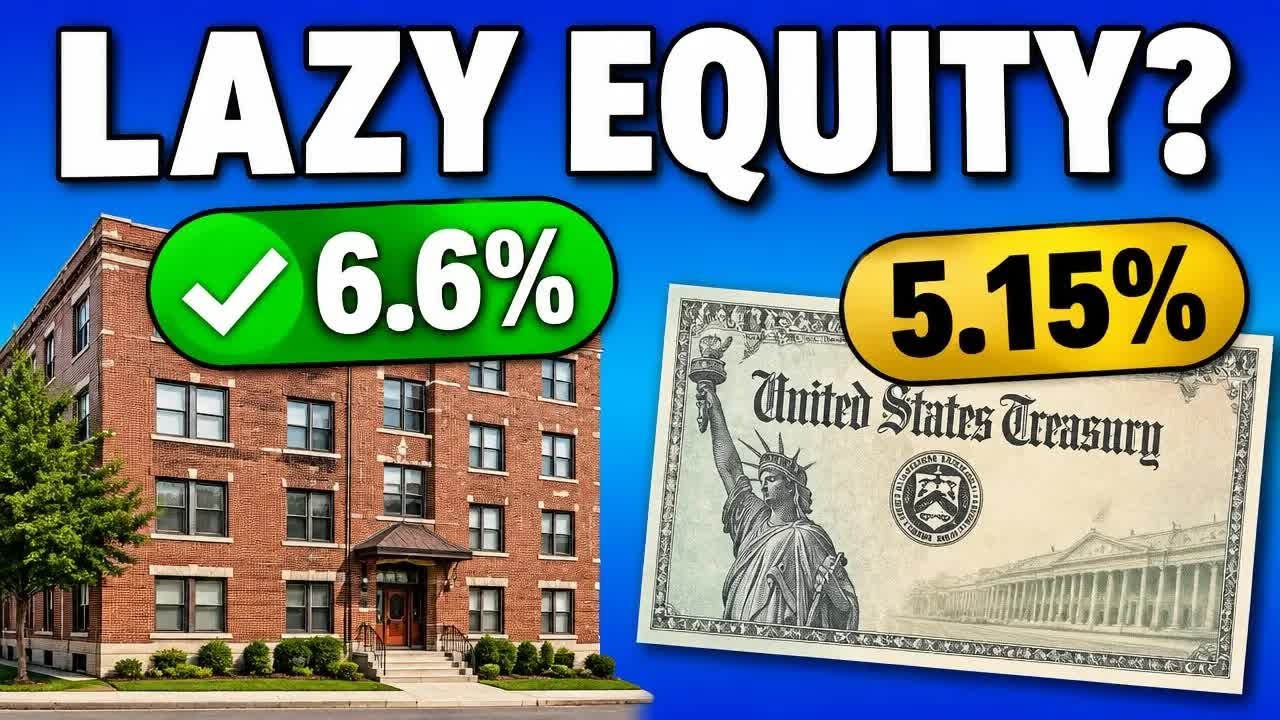
The 10-year Treasury closed at 5.15% on Friday, November 13, 2026, which means anybody with cash can lend it to the U.S. government for 10 years and collect that rate with no roof to replace and no late-night calls from a tenant. If you own an apartment building you paid off years ago, that number raises a fair question about whether all that equity is earning enough. When I'm advising investors on how to evaluate a real estate deal, I compare the building's cap rate on today's value with what the 10-year Treasury pays, and then I check what a buyer could afford to pay for it.
Prefer to watch? Watch the full video on YouTube.
What the 10-year Treasury pays
The 10-year Treasury yield is the interest rate you earn for lending money to the U.S. government for 10 years. If you hold the note to maturity, you collect the interest every year and get your principal back, so the dollar income stays the same. If you sell before maturity, the price can be higher or lower than what you paid.
The U.S. Treasury's daily par yield curve put the 10-year at 5.15% as of November 13, 2026, and that is the rate the video used. By November 24, 2026, it had come down to 4.91%. I run the example at 5.15% first so it matches the video, and then at 4.91%, because that is the latest close as of this writing. When you run your own numbers, use the latest yield on the day you do it. The FRED 10-year series shows the daily history.
Compare on what the building is worth today
Compare a building to a Treasury with the cap rate on what the building is worth today, whatever you paid for it years ago. Today's value is the money you could put somewhere else. The cap rate is net operating income divided by value, and net operating income, or NOI, is the rent you collect minus vacancy and operating expenses, before any loan payment.
I put the yearly replacement reserve for the roof, the parking lot, and the heating and cooling equipment inside operating expenses, so it comes out above NOI. Some lenders and appraisers put reserves below NOI instead, so when somebody hands you a cap rate, ask how they handled reserves before you compare it with yours. A one-time roof project is a separate use of cash that you plan for on its own, and a capital addition, like building a new structure on the lot, stays below NOI.
The example: a paid-off 10-unit building
The building in this example is made up. It is paid off and worth $1,200,000 today, and each of the 10 units rents for $1,200 a month, which is $144,000 a year.
- Vacancy at 5% takes $7,200, which leaves $136,800 of collected rent.
- Operating expenses, including taxes, insurance, repairs, management, utilities, and a yearly replacement reserve, run $57,600, about 42% of collected rent.
- NOI is $79,200, and $79,200 on $1,200,000 is a 6.6% cap rate.
The video put vacancy and operating costs together at 45% of the rent. I split them apart here so you can change each one. My starting expense ratio for a building with 2 to 14 units is about 40% of collected rent, and at exactly 40% this example would have $82,080 of NOI, a cap rate of about 6.84%. Replace every one of these inputs with the real numbers on the building you are looking at.
Rental income vs Treasury income
Put the same $1,200,000 in 10-year Treasuries and compare the dollars.
- At 5.15%, Treasuries pay $61,800 a year. The building's $79,200 beats that by $17,400 a year, about $145 per door per month.
- At 4.91%, Treasuries pay $58,920, and the gap grows to $20,280 a year, about $169 per door per month.
- After a 6% selling cost, you would net about $1,128,000. That money earns about $58,092 at 5.15% or about $55,385 at 4.91%, so the building pays about $176 or about $198 per door per month more.
Those comparisons come before any taxes on a sale. Ask your CPA about depreciation recapture and capital gains, and about how Treasury interest is taxed, because the after-tax picture can look different from this one.
So on this example, the paid-off building beats the 10-year, by roughly $145 to $200 per door per month depending on the yield and whether you count selling costs. That gap is your pay for being the landlord, and it can be wiped out by one bad year with a new roof, a long vacancy, or a big tax bill. A Treasury held to maturity pays the same every year. A building's rents can rise and a Treasury coupon never will, so both sides have a point. If you spent years building that equity, a thin margin can feel discouraging, and a tired owner who sees the same margin may be ready to listen to an offer.
The same building from a buyer's side
Now picture a buyer who wants this building at $1,200,000. My minimum is $200 per door per month, net after all expenses including the loan payment. On 10 doors that is $2,000 a month, or $24,000 a year.
Take a bank loan at 70% loan to value, which is $840,000, with $360,000 down. I use 7.5% and a 30-year schedule in this example. Get a written quote on the day you run it, because loan terms move, and update the rate and the term before you rely on any number here. At 7.5%, the payment is about $5,873 a month, or about $70,481 a year.
- NOI of $79,200 minus the loan payment leaves about $8,719 a year, about $73 per door per month.
- Debt service coverage, which is NOI divided by the loan payment, is about 1.12.
- If the lender amortizes over 25 years, the payment is about $74,490 a year and the leftover drops to about $39 per door per month.
That misses the $200 minimum by a lot. To keep $200 per door with that bank loan, the price would have to come down to about $940,000. The loan costs about 8.4% of the loan balance each year in payments, while the building earns 6.6% of its value, so the borrowing pulls the buyer's return down. That is called negative leverage, and the Treasuries vs real estate guide walks through it for a new purchase.
A seller-carry offer
Now picture the offer a different way. The buyer pays the full $1,200,000 price, puts down the same $360,000, and asks the owner to carry the note, which means the owner acts like the bank on the other $840,000. In this example the note is interest-only at 5.5%.
At 5.5%, the owner earns $46,200 a year on the note. That is more than the $43,260 the same $840,000 would earn in 10-year Treasuries at 5.15%, and more than the $41,244 it would earn at 4.91%, and the owner has no tenants to manage. The buyer pays $46,200 and keeps $33,000, which is about $275 per door per month, so the offer clears the $200 minimum.
On this building, any note rate above the 10-year yield and up to about 6.5% leaves the buyer at $200 per door or better, because 6.57% interest on $840,000 uses $55,200 of the $79,200 NOI. A seller may want more than the Treasury rate, since a note carries a risk a Treasury doesn't, and a bigger down payment or a shorter term can be part of that conversation.
The video used 20% down and a $960,000 note, which left the buyer about $220 per door. This guide uses 70% loan to value so the note is the same size as the bank loan, and the only differences are the rate and the interest-only payment. The terms are an example, not an offer on a real building.
The risks for both sides
Interest-only means the buyer pays only interest on the $840,000, so when the term is up, the buyer owes the whole amount in one lump-sum payoff, called a balloon. The buyer needs a plan to refinance or sell, and that plan can fail if rates are higher or the building's income has dropped by then.
The owner takes the risk that the buyer stops paying. The owner's protection is the building itself, so the note and the mortgage or deed of trust need to be drawn up by a real estate attorney. If the owner still has a loan, it usually has to be paid off at closing, which is why this works best on a building with little or no debt. The seller financing pillar and the balloon-test guide are the places to pressure-test the terms.
Should you sell your rental, keep it, or carry the note?
If you own a paid-off rental, you have three choices with the equity, which are to keep the building, to sell it and buy Treasuries, or to carry a note for a buyer. Each one changes your income, your risk, and your tax bill, so run all three with your CPA before you decide.
When I look for a seller who might carry a note, I look for an owner who has had the building a long time, has little or no debt, and is tired of managing it. That owner may not need all the cash at closing, and a regular payment can sound better than another roof.
The recap
- The 10-year Treasury yield was 5.15% as of November 13, 2026, and 4.91% as of November 24, 2026, per the U.S. Treasury's daily par yield curve.
- In a paid-off 10-unit example worth $1,200,000 with $79,200 of NOI, the cap rate is 6.6%, and the building pays about $145 per door per month more than 10-year Treasuries at 5.15%, or about $169 at 4.91%.
- With a 70% bank loan at 7.5%, a buyer keeps about $73 per door per month, well under a $200 minimum. A 5.5% interest-only seller note leaves about $275.
- The owner who carries that note earns more than the 10-year Treasury pays on the same money, and both sides take on balloon and default risk.
The building, its $1,200,000 value, the rents, the 5% vacancy, the $57,600 of operating expenses, the 6% selling cost, the 7.5% bank loan, and the 5.5% seller-carry terms are teaching examples and are rounded. Treasury yields are cited as of the dates given. This guide is for education only and is not financial, tax, or legal advice. Update the loan terms to a current quote, and check the documents with the proper professionals.
Learn to compare a building with the 10-year Treasury
If you want help running cap rate and seller-financing math on real deals with other investors, come join us in Commercial Real Estate 101 on Skool. Inside, we teach you how to compare a building with the 10-year Treasury, how to underwrite against a $200 per door per month minimum, and how to write a seller-financing offer that works for a tired owner.
Pull three small apartment buildings near you that have been owned for 10 years or more, figure each one's cap rate on today's value, and compare it with the latest 10-year yield. Then call each owner and offer the price, with the owner carrying the note at a rate between the 10-year yield and the rate that keeps you at $200 per door. Most of those owners will say no, and a deal that misses the minimum is still a pass, but if you never make the attempt, you'll never get what you want.
Frequently asked questions
How do I compare a paid-off rental to the 10-year Treasury?
Use the cap rate on what the building is worth today, whatever you paid for it years ago. The cap rate is net operating income divided by value, and net operating income is the rent you collect minus vacancy and operating expenses, before any loan payment. Then multiply the same value by the 10-year Treasury yield and compare the two dollar amounts. In the example, a $1,200,000 building with $79,200 of NOI has a 6.6% cap rate, and the same money in 10-year Treasuries at 5.15% pays $61,800 a year, so the building pays $17,400 more, about $145 per door per month. The building and its numbers are an example.
Should I sell my paid-off rental and buy Treasuries?
The answer depends on your numbers, your taxes, and the building. In the example, the building beats the 10-year Treasury by roughly $145 to $200 per door per month, depending on the yield and whether you count a 6% selling cost. One bad year with a new roof, a long vacancy, or a big tax bill can wipe that gap out, while a Treasury held to maturity pays the same every year. Rents can rise and a Treasury coupon never will. Ask your CPA about depreciation recapture, capital gains, and how Treasury interest is taxed before you decide. This is education, not financial, tax, or legal advice.
What is the 10-year Treasury yield right now?
The U.S. Treasury's daily par yield curve put the 10-year at 5.15% as of November 13, 2026, and at 4.91% as of November 24, 2026. Yields change every business day, so look up the latest close on the Treasury or FRED site before you run your own comparison.
Can a seller-financed note pay an owner more than the 10-year Treasury?
It can in the example. A buyer puts 30% down on a $1,200,000 building and the owner carries the other $840,000 at 5.5% interest-only. The owner earns $46,200 a year, compared with $43,260 on the same money in 10-year Treasuries at 5.15% or $41,244 at 4.91%, and the buyer keeps about $275 per door per month. A note carries a risk a Treasury doesn't, so an owner may ask for a higher rate, a bigger down payment, or a shorter term. These terms are an example, not an offer.
What is a balloon payment on an interest-only seller note?
Interest-only means the buyer pays only the interest, so the principal stays at $840,000 in the example. When the term ends, the buyer owes the whole amount in one lump-sum payoff, called a balloon, and needs a plan to refinance or sell. That plan can fail if rates are higher or the building's income has dropped. A real estate attorney should draw up the note and the mortgage or deed of trust.