
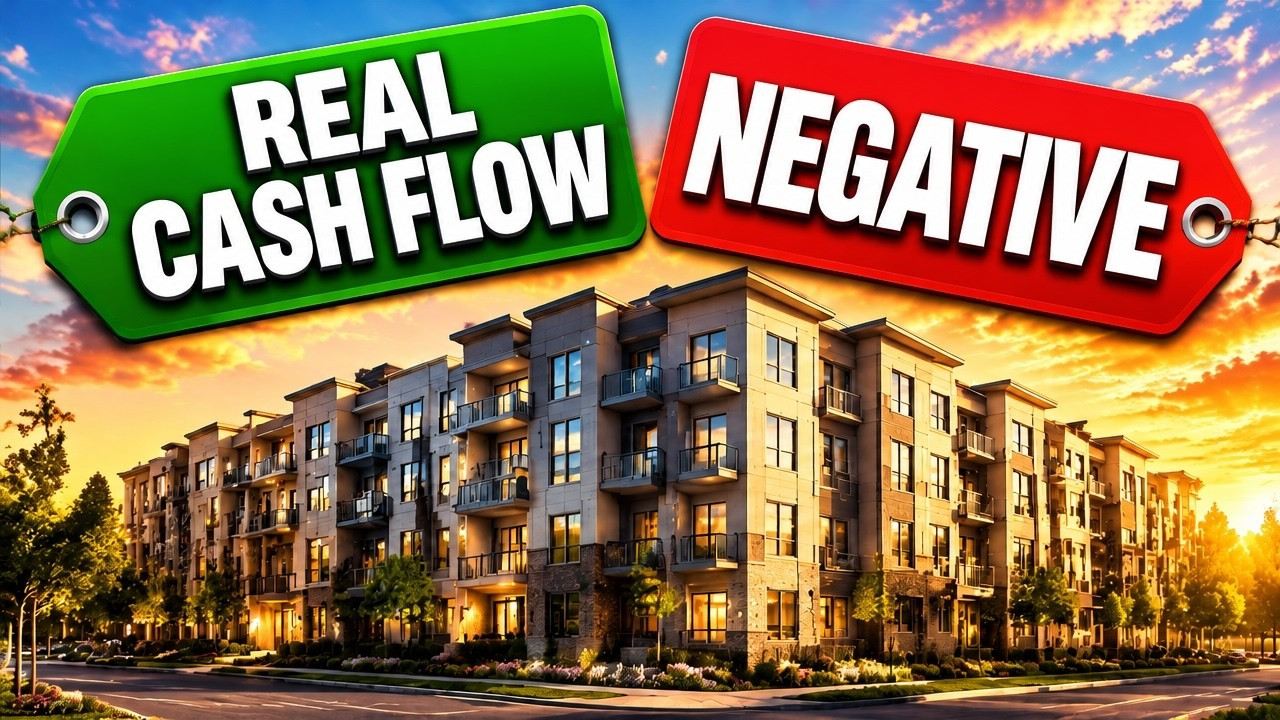
Some properties don't just break even, they eat your money every single month, and investors call them alligators. This 92-unit apartment building was listed at $16 million. If you bought it at that price, you'd put down almost $5 million and still lose money every month.
This one came up on one of our community calls, and it's a very important concept to understand when you're evaluating properties. Before you read the math, take a guess at how much this building would cost you every month. Is it $1,000, $5,000, or more?
Prefer to watch? Watch the full video on YouTube.
What is an alligator property?
An alligator is a property with negative cash flow. The rent comes in and it's not enough, because the mortgage, the taxes and the repairs cost more than the building makes. Every month, you feed it from your own pocket.
Running the numbers comes down to a very simple equation. Your NOI, the net operating income, basically rents minus expenses, minus your loan payment is your cash flow. If that number is below zero, you own an alligator.
It's not just big buildings, either. A single rental can be an alligator too. Say the mortgage, taxes and insurance on a single-family rental come to $2,000 a month, and it rents for $1,700. You're down $300 a month before the first repair, and that doesn't seem like a good investment.
Why would anyone buy a property with negative cash flow? Usually it's one of three reasons. They trust the seller's numbers, they're betting the price goes up, or they grossly underestimated the real operating expenses.
Step 1: a quick gut check on the 92-unit
Start with price per unit. $16 million divided by 92 units is about $174,000 a door.
The seller's numbers show about $1.2 million in income. They used just 2% vacancy and expenses of about 33%. That leaves an NOI of about $809,000 a year. At $16 million, that's about a five cap, meaning the building earns about 5% of the price before any loan. That's just too low for most markets, although on the West Coast it may not be crazy.
Step 2: run the bank test on the seller's numbers
The bank test simply answers one question. Would a bank even lend on this deal?
For an apartment building like this, I use current commercial bank terms: 30% down, a 7.5% interest rate and a 25-year amortization schedule. On $16 million, that's about $4.8 million down and an $11.2 million loan. The payment comes to about $82,767 a month.
The seller's NOI works out to about $67,487 a month. Using their own numbers, you're short about $15,000 every month. That's about $183,000 a year out of your pocket, after putting down almost $5 million. And that's the good version, because it uses the seller's numbers.
Step 3: rebuild the NOI with realistic assumptions
Now let's review the seller's assumptions.
- Vacancy. 2% isn't enough. I use at least 5%. The income times 95% is about $1.18 million.
- Expenses. For an apartment complex this size, I use a 45% expense ratio, not 33%.
That gives a more realistic NOI of about $651,000 a year, or about $54,250 a month. Subtract the same $82,767 mortgage payment and you're losing about $28,500 a month. That's about $342,000 a year.
Keep in mind we haven't visited the property, so we don't know much about its condition. All we have to go on is the listing photos. Based on the photos, there's new carpet, but old appliances, dated countertops and old coil stoves. They tried to put lipstick on a pig, and if you bought this pig at $16 million, it would turn into an alligator for you.
Step 4: what is the building actually worth?
Now let's use the NOI to figure out what this building would even be worth. Let's be generous and call it a six cap.
- With the seller's NOI of about $809,000, a six cap puts the value at about $13.5 million.
- With the realistic NOI of about $651,000, it's about $10.85 million.
They're asking $16 million. That's more than $5 million over what the math supports.
This is pretty common, and a lot of listings look a lot like this. Sellers are often out of touch with the reality buyers are dealing with. It's not always this bad, but the NOI a seller gives you is often too high.
The break-even test
Here's another way to see how far off this one is. To just break even on that $82,767 monthly payment, the building needs an NOI of about $993,000 a year. The realistic NOI is about $651,000, which leaves it about $342,000 short every year.
And break even isn't the goal. The goal is cash flow, with a cushion for the bad months.
How to spot an alligator before you sign
- Rebuild the NOI. Use at least 5% vacancy and a real expense ratio. For a large apartment complex, I use 45%.
- Run the bank test. Use 30% down, about 7.5% interest and a 25-year payment schedule.
- Subtract the payment from the NOI. If the number is red, you've found an alligator.
That doesn't mean you can never buy it. It means you can't buy it at that price. Either the price comes way down, or the terms change. A seller who carries the note on seller financing terms can sometimes fix a payment problem that a bank loan can't, but the building still has to cover the payment.
How did your guess compare to $28,500 a month?
What this means for you
An alligator is a property that costs more than it makes. The seller probably won't tell you that, but the math will. Rebuild the NOI, run the bank test, and think twice before you buy a deal you have to feed.
If you want the full bank test step by step, the DSCR walkthrough on a 40-unit is the next one to read. Our commercial financing guide covers the loan side.
The loan terms here (30% down, 7.5%, 25 years) are what I use as typical commercial bank terms as of the video, and they'll move with the market. The deal figures come from the listing and our community call, not a site visit. Run your own numbers and talk to your own lender.
Get a second set of eyes on your deal
If you want help evaluating a deal like this before you sign, or you want a second set of eyes on the numbers, come join us in Commercial Real Estate 101 on Skool. You'll get scripts, toolkits, deal breakdowns, and live deal analysis every week.
And go make some offers.
Frequently asked questions
What is an alligator property in real estate?
An alligator is a property with negative cash flow, where the mortgage, the taxes and the repairs cost more than the building makes. Every month, you feed it from your own pocket.
How do you calculate cash flow on a rental property?
Take the NOI, which is basically rents minus expenses, and subtract your loan payment, and what's left is your cash flow. If that number is below zero, you own an alligator.
Why would anyone buy a property with negative cash flow?
Usually it's one of three reasons: the buyer trusts the seller's numbers, the buyer is betting the price goes up, or the buyer grossly underestimated the real operating expenses.
What vacancy rate and expense ratio should I use to underwrite an apartment building?
I use at least 5% vacancy, and for a large apartment complex I use a 45% expense ratio. In the 92-unit example, the seller used just 2% vacancy and expenses of about 33%, which is how the seller's NOI ended up too high.
How do you spot an alligator property before you buy?
Rebuild the NOI with at least 5% vacancy and a real expense ratio, run the bank test at the terms I used as of the video (30% down, about 7.5% interest and a 25-year schedule), then subtract the payment from the NOI. If the number is red, you can't buy it at that price unless the price comes way down or the terms change.