
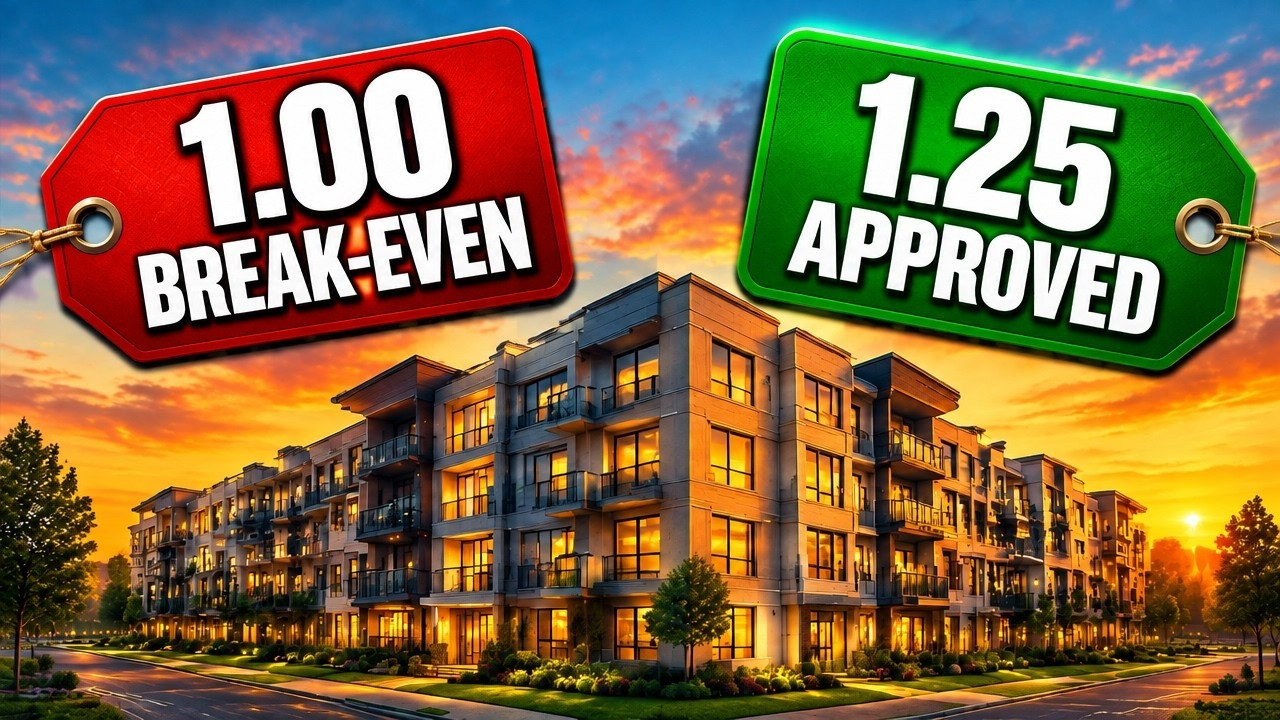
This 40-unit is listed just under $2 million. Before I spend another minute on a deal like this, I run one test, and if it fails, I usually move on. It's the same test a bank runs before it lends you a dollar.
This deal came up on one of our community coaching calls. The seller says it nets about $18,300 a month. Before you read the math, make a guess: would a bank write a loan on it, pass or fail?
Prefer to watch? Watch the full video on YouTube.
What is DSCR?
The test is called DSCR, which stands for debt service coverage ratio, and it's simpler than it sounds. Debt service is just your loan payment. DSCR asks one question: how much cushion does the owner have to pay the mortgage?
You take the NOI, what the building makes after expenses and before the mortgage, and divide it by the loan payment.
- DSCR of 1.0 means the building makes exactly enough to pay the bank, with nothing left for you.
- Under 1.0 means you're paying part of the mortgage out of your own pocket.
- 1.25 or higher is what most banks want to see. For every dollar of mortgage, the building makes $1.25.
My bank test has two parts. Does it cash flow, and is the DSCR 1.25 or higher? A deal has to pass both.
A quick DSCR example
Say a building nets $125,000 a year and the mortgage costs $100,000 a year. $125,000 divided by $100,000 is 1.25, which is right at the line.
The bank wants that extra 25% because properties have bad months. Units go empty, a boiler dies, or maybe insurance rates go up unexpectedly. That cushion helps the bank make sure you can still pay them when something goes wrong.
Running the bank test on the 40-unit
Start with a quick gut check on price per unit. $1,975,000 divided by 40 is $49,375 a door. For a 40-unit, that's not crazy, so it's worth running.
For the bank test on a 40-unit apartment building, I use typical commercial loan terms: 30% down at the going market rate of 7.5% interest, with a 25-year amortization schedule.
- Down payment. 30% of $1,975,000 is around $592,500.
- Loan amount. You'd borrow $1,382,500 from the bank.
- Payment. On 25 years at 7.5%, the payment is about $10,217 a month.
- NOI. The seller says the building nets $18,298 a month, about $219,000 a year.
- DSCR. $18,298 divided by $10,217 is about 1.79.
The bank wants 1.25, and this is almost 1.8. Cash flow is about $8,080 a month after the mortgage, or about $202 per unit. It cash flows, and it clears 1.25 with room to spare, so this one passes.
On the call, the read was, "If this NOI is real, I'd be digging in really fast." Even if the rate climbed to 8.5%, the DSCR would still be about 1.64.
The better question: how far can the NOI fall?
Notice the word "if" in that quote. The DSCR is only as good as the NOI you feed it, and this NOI came from the seller. In our experience, the seller's NOI often isn't real, which is why I look for the floor.
Take the payment, $10,217, times 1.25, times 12 months. That's about $153,000 a year, and that's the floor. The NOI could drop from about $219,000 to about $153,000 and still pass. That's a cushion of about $66,000 a year.
The floor is the number I'd keep in my back pocket while I verify, because it tells you how wrong the seller's NOI can be before a normal bank loan stops working. If the real NOI lands above the floor, you still have a bankable deal. If it lands below, you're looking at a lower price or different terms.
When this same building came up on another call, the numbers did move. It was about 92% occupied, and it needed about $175,000 of work to push the rents up. If you trim the NOI to be careful, say to about $205,000, and run the test again, the DSCR is still about 1.67. It still passes.
After it passes, verify the NOI
The deal passed the first test. Now you verify it.
- Add up the last 12 months of expenses. For a 40-unit, they should be around 40 to 45% of collected rent. If they're way lower, the NOI is probably too high.
- Count the units that are actually rented and paying. Occupied and paying aren't always the same thing.
- List the repairs that are coming. Those don't show up in the NOI.
To be clear, the DSCR alone won't tell you a deal is good, but it can tell you the deal is worth your time.
When a deal fails the bank test
On that other call, the group looked at a second way to buy it. Instead of the bank, the seller carries the loan, with about $200,000 down and a payment around $9,300 to $9,600 a month. The DSCR test doesn't apply in the same way there, but the building still covers the payment. Knowing your DSCR helps you pick which way to finance a deal.
If a deal fails the bank test, it doesn't always mean you walk away. It means the price is too high for a normal bank loan. You can lower the price, or ask the seller to carry the financing on seller financing terms. Seller financing usually doesn't need a 1.25 ratio, because that's something banks look at and most sellers don't.
Sometimes a deal fails so badly it doesn't just miss 1.25, it loses money every single month. We call that an alligator property because you have to constantly feed it. The alligator breakdown on a 92-unit listed at $16 million shows what that looks like.
The recap
- DSCR is NOI divided by your loan payment.
- Banks want 1.25 or more.
- On a 40-unit, run it with 30% down, about 7.5% and 25 years.
- Find the floor, meaning how low the NOI can go and still pass.
- Verify the NOI before you trust the answer.
The loan terms here are what I use as typical commercial bank terms as of the video, and the deal numbers come from the seller and our coaching calls. Your lender's terms will vary, so run your own numbers. Our commercial financing guide covers the loan options.
Run deals like this with other investors
If you want to learn how to run the bank test on a deal like this, or you want other investors walking the numbers with you, come join us in Commercial Real Estate 101 on Skool. You'll get scripts, toolkits, deal breakdowns, and live calls where we work through real listings every week.
And go make some offers.
Frequently asked questions
What is DSCR in real estate?
DSCR stands for debt service coverage ratio, and it's the NOI divided by your loan payment. DSCR asks how much cushion the owner has to pay the mortgage, so 1.0 means the building makes exactly enough to pay the bank and under 1.0 means you're covering part of the mortgage yourself.
What is a good DSCR for a bank loan?
Most banks want to see a DSCR of 1.25 or higher, meaning the building makes $1.25 for every dollar of mortgage. The bank wants that extra 25% because properties have bad months, like empty units, a dead boiler or an unexpected insurance increase.
How do you calculate DSCR?
Divide the yearly NOI by the yearly loan payment. As an example, a building that nets $125,000 a year with a $100,000 yearly mortgage has a DSCR of 1.25, which is right at the line.
How low can the NOI go and still pass the bank test?
Find the floor by taking the monthly payment times 1.25 times 12 months. On the 40-unit example, a $10,217 payment gives a floor of about $153,000 a year, so the seller's NOI of about $219,000 could drop about $66,000 a year and still pass.
What if a deal fails the DSCR bank test?
Failing the bank test usually means the price is too high for a normal bank loan, so you can lower the price or ask the seller to carry the financing. Seller financing usually doesn't need a 1.25 ratio, because that's something banks look at and most sellers don't, but the building still has to cover the payment.