
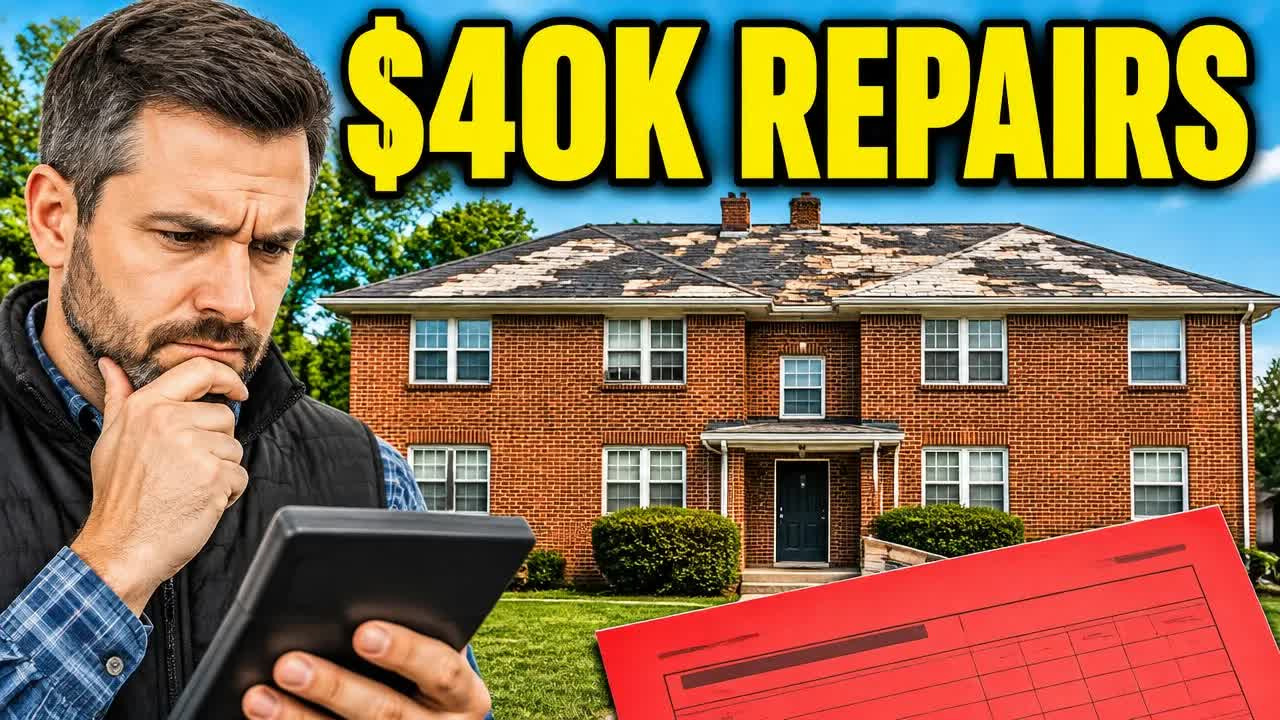
When a bank takes a building back, a lot of investors assume the bank will sell it cheap just to get it off the books. If you're thinking about buying one of those properties, you have to tell a real discount from a building that just hands you the bank's problem, because the roof, the vacant units, and the unpaid repairs all come with the purchase. When I'm advising investors on how to evaluate a real estate deal, I rebuild the income, budget the repairs, and get a real loan quote before I treat the price as a bargain.
Prefer to watch? Watch the full video on YouTube.
What a bank-owned property is
A bank-owned property is one the lender took back after the owner stopped paying the loan. You may also hear it called REO, which means real estate owned. A loan is delinquent when payments are overdue, and the delinquency rate tells you what share of loans are behind.
The stress is not spread evenly
A Kidder Mathews research summary put bank-held commercial real estate delinquency at about 1.56% in the first quarter of 2026, far below the roughly 8.76% peak around the financial crisis. Office loans inside commercial mortgage-backed securities, which are loans bundled together and sold to bond investors, were much more troubled at about 11.58%. Kidder Mathews published that summary on September 9, 2026, compiling Federal Reserve data for the bank figures and Mortgage Bankers Association and Trepp data for the office CMBS figures.
Those three figures come from different loan pools, and early-year figures aren't a count of every building being taken back today. The opportunity is a specific property whose price and condition you can verify, not a national claim that every bank is desperate.
An eight-unit example
Take a hypothetical eight-unit property with $18,000 a month in potential rent, which is $216,000 a year if every unit pays. These numbers are an example, not records from a real bank listing.
Allow 8% vacancy and you have about $199,000. I use 8% here as a round number in the 5% to 10% vacancy range I underwrite with. If operating expenses use 40% of that collected income, net operating income, which is the income after vacancy and operating costs but before the mortgage, comes to about $119,000 a year. For a building with 2 to 14 units, I use about 40% as the starting expense ratio, and in this example that 40% includes a reserve allowance. I treat reserves as an operating expense.
Now suppose the inspection finds $40,000 of first-year capital work, which means big one-time repairs like a roof or a boiler, as opposed to routine maintenance. That single repair bill equals about a third of a full year's net operating income, and you have to fund it on top of your down payment and closing costs.
See the NOI guide for how net operating income is built.
The loan has to carry the building while you fix it
Get an actual loan quote for that specific building, then test what happens if occupancy recovers slowly or the repairs cost more. A residential mortgage average isn't a quote for an eight-unit commercial loan, and the bank's old loan balance doesn't tell you what the building is worth to you. Loan terms change, so use the quote you can get at the time of writing and update it based on what's happening in the marketplace right now.
I would work backward from realistic income, debt payments, reserves, and the cash needed for repairs to decide the bid. A real discount is one that still works after you put the missing expenses back in, and a clean-looking discount can disappear the moment you do.
The DSCR guide and the DSCR bank test on a 40-unit show how a lender sizes that loan.
Why seller financing usually is not on the table
A bank usually won't act as the lender on a building it just took back. On a regular listing, seller financing can make up for a price that is a little high. On a bank-owned deal, the price and your own loan have to do that work, which is one more reason the price has to be right.
Ask for the leases, actual collections, operating bills, title work, and access for an inspection, and make an offer only at a price you can afford to operate.
Some banks will turn down your number, but if you never bid, you'll never find the one that takes it.
The recap
- A bank-owned property, sometimes called REO, is a building the lender took back after the owner stopped paying the loan.
- As of Kidder Mathews' September 9, 2026 summary, bank-held commercial real estate delinquency was about 1.56% in the first quarter of 2026, far below the roughly 8.76% peak around the financial crisis. Office CMBS delinquency was about 11.58%. Those figures come from different loan pools.
- In a teaching example of an eight-unit with $216,000 of potential rent, 8% vacancy leaves about $199,000, and a 40% expense ratio (including a reserve allowance) leaves about $119,000 of net operating income. A $40,000 first-year capital bill is about a third of that income, funded on top of the down payment.
- Get a real loan quote for the specific building, then work backward from income, debt payments, reserves, and repair cash to decide the bid.
- Banks rarely carry the note on a building they just took back, so the price and your own loan have to carry the deal.
The eight-unit numbers are a teaching example. The delinquency figures are cited as of the Kidder Mathews September 9, 2026 summary of first-quarter 2026 data. This guide is for education only and is not financial, tax, or legal advice. Verify every figure against the actual property before you bid, and check the terms with the proper professionals.
Learn to underwrite a bank-owned building before you bid
If you want to learn how to underwrite a bank-owned building, from the repair budget to the loan, before you put your money into the deal, come join us in Commercial Real Estate 101 on Skool. Inside, we teach you how to rebuild the income, price the repairs, and test the loan before you bid.
Ask for the documents, inspect the building, and make an offer only at a price you can afford to operate.
Frequently asked questions
What is a bank-owned property?
A bank-owned property is one the lender took back after the owner stopped paying the loan. You may also hear it called REO, which means real estate owned. A loan is delinquent when payments are overdue, and the delinquency rate tells you what share of loans are behind.
Are banks dumping commercial buildings cheap in 2026?
Not as a national pattern. A Kidder Mathews research summary published September 9, 2026, put bank-held commercial real estate delinquency at about 1.56% in the first quarter of 2026, far below the roughly 8.76% peak around the financial crisis. Office loans inside commercial mortgage-backed securities were much more troubled at about 11.58%. Those figures come from different loan pools, and early-year figures aren't a count of every building being taken back today. The opportunity is a specific property whose price and condition you can verify.
How can a $40,000 repair bill change a bank-owned eight-unit?
In a teaching example of an eight-unit with $18,000 a month in potential rent, or $216,000 a year, 8% vacancy leaves about $199,000, and a 40% expense ratio (including a reserve allowance) leaves about $119,000 of net operating income. A $40,000 first-year capital bill, such as a roof or a boiler, equals about a third of that income and has to be funded on top of the down payment and closing costs. These numbers are an example, not records from a real bank listing.
Will the bank finance a building it just took back?
A bank usually won't act as the lender on a building it just took back. On a bank-owned deal, the price and your own loan have to do the work that seller financing might do on a regular listing. Get an actual loan quote for that specific building. A residential mortgage average isn't a quote for an eight-unit commercial loan, and the bank's old loan balance doesn't tell you what the building is worth to you.
What should you ask for before bidding on a bank-owned building?
Ask for the leases, actual collections, operating bills, title work, and access for an inspection, and make an offer only at a price you can afford to operate. Work backward from realistic income, debt payments, reserves, and the cash needed for repairs to decide the bid. A real discount is one that still works after you put the missing expenses back in.